Editorial + Minimal · AI image style prompt
Crimson Vanishing Point Editorial
Monochrome ultra-wide forced-perspective corridors with a lone silhouette walker, giant scarlet geometric letter planes receding toward the vanishing point, and motion-blurred crowds.
What this style does
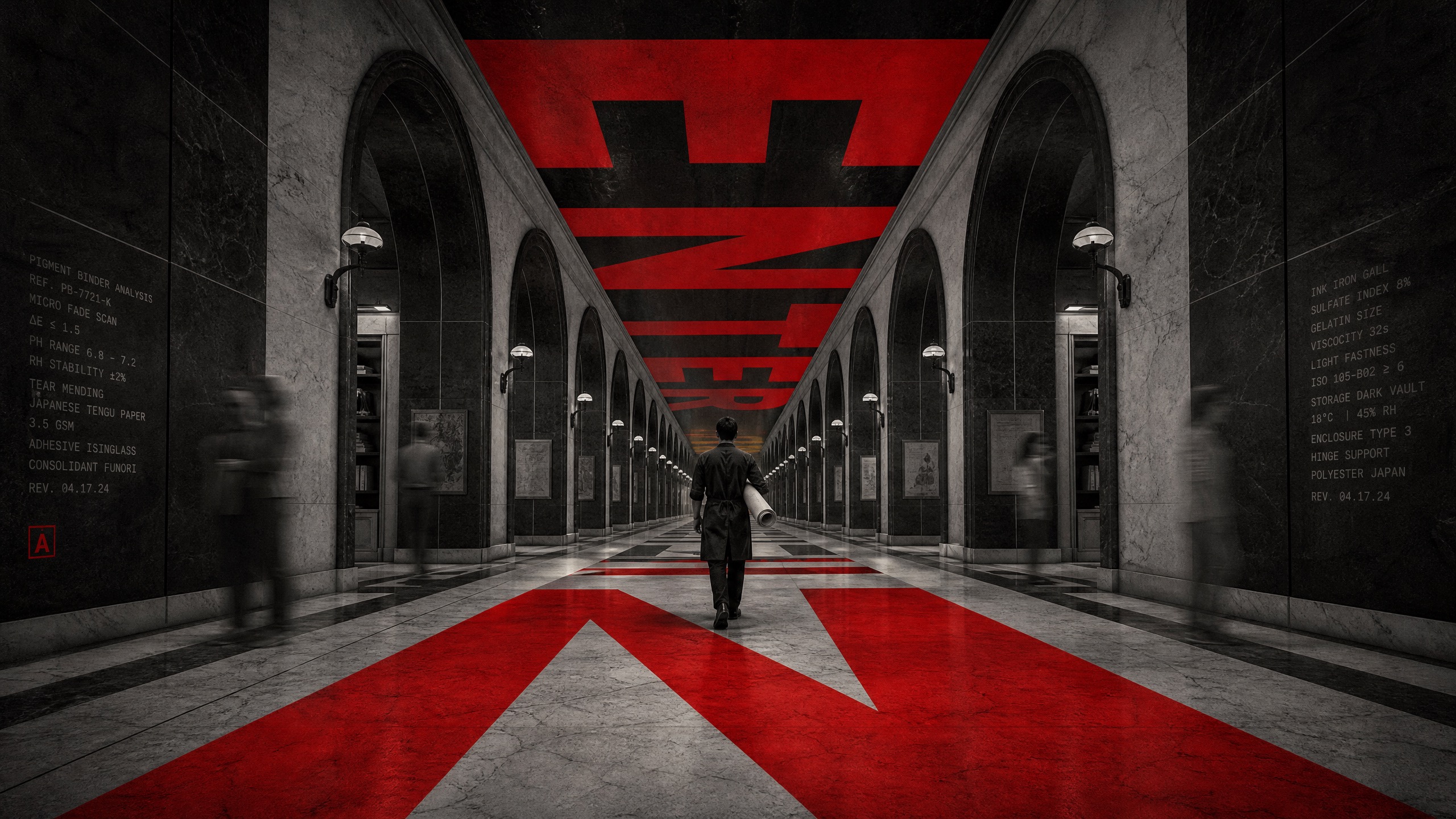
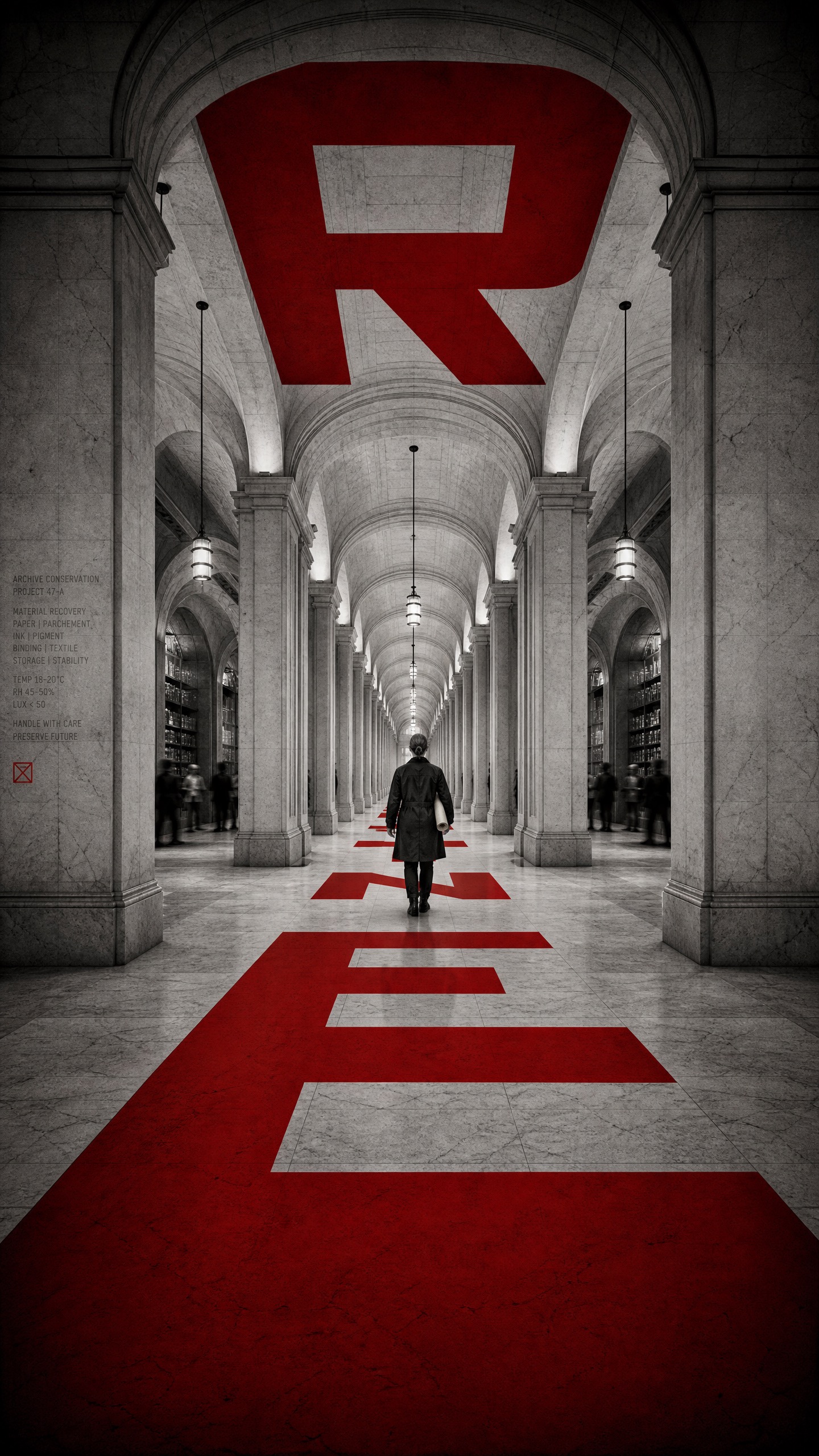
A high-pressure editorial-poster system that turns a monochrome, ultra-wide one-point-perspective public interior into a typographic corridor. A lone central figure moves away from the viewer as enormous scarlet letters become receding floor, wall, and ceiling planes, while blurred peripheral bodies and faint technical text create urgency without clutter.
Signature traits
- Use a strongly centered one-point perspective inside a long monumental public interior, with repeated bays, arches, ceiling ribs, or light fixtures converging at a single deep vanishing point.
- Render the architecture almost entirely in high-contrast black, white, and silver-gray, with coarse photographic grain and a slightly documentary, low-light feel.
- Place one lone adult figure on the central axis, walking away or moving forward into the depth of the corridor, with the body read primarily as a dark silhouette.
- Keep the central figure smaller than the architecture and typography, approximately 15–25% of canvas height, so the space and word planes dominate the drama.
- Add one to three enormous scarlet-red uppercase word fragments or geometric letter planes aligned to the exact vanishing-point perspective, appearing on the floor, ceiling, or spanning the central corridor.
- Use large red letter planes nearest the viewer and progressively smaller red fragments as they recede toward the vanishing point; they must be dimensional perspective objects, not a flat title pasted over the scene.
style.json
{
  "style_name": "Crimson Vanishing Point Editorial",
  "style_slug": "crimson-vanishing-point-editorial",
  "style_version": "custom-16x9-9x16-1.0",
  "style_summary": "A high-pressure editorial-poster system that turns a monochrome, ultra-wide one-point-perspective public interior into a typographic corridor. A lone central figure moves away from the viewer as enormous scarlet letters become receding floor, wall, and ceiling planes, while blurred peripheral bodies and faint technical text create urgency without clutter.",
  "category": "Editorial + Minimal",
  "environment_variables": {
    "SUBJECT": "main subject",
    "SUBJECT_ACTION": "main action",
    "PRODUCT_OR_PROP": "object, product, or prop",
    "LOCATION": "environment or setting",
    "BACKGROUND_ELEMENTS": "secondary scene details",
    "MAIN_TEXT": "main headline or graphic text",
    "SECONDARY_TEXT": "supporting text",
    "ACCENT_SYMBOL": "decorative symbol",
    "WARDROBE_STYLE": "styling direction",
    "STYLE_FIDELITY_ANCHORS": "top-level style constants injected at render time",
    "SOURCE_CONTENT_TO_AVOID": "top-level content exclusions injected at render time",
    "ASPECT_RATIO": "16:9 or 9:16 injected at render time"
  },
  "style_fidelity_anchors": [
    "Use a strongly centered one-point perspective inside a long monumental public interior, with repeated bays, arches, ceiling ribs, or light fixtures converging at a single deep vanishing point.",
    "Render the architecture almost entirely in high-contrast black, white, and silver-gray, with coarse photographic grain and a slightly documentary, low-light feel.",
    "Place one lone adult figure on the central axis, walking away or moving forward into the depth of the corridor, with the body read primarily as a dark silhouette.",
    "Keep the central figure smaller than the architecture and typography, approximately 15–25% of canvas height, so the space and word planes dominate the drama.",
    "Add one to three enormous scarlet-red uppercase word fragments or geometric letter planes aligned to the exact vanishing-point perspective, appearing on the floor, ceiling, or spanning the central corridor.",
    "Use large red letter planes nearest the viewer and progressively smaller red fragments as they recede toward the vanishing point; they must be dimensional perspective objects, not a flat title pasted over the scene.",
    "Include peripheral passersby only as soft motion-blurred gray silhouettes near the side walls, leaving the center axis clear and focused.",
    "Place sparse, faint off-white or gray technical microtext clusters at the lower side walls or mid-distance, like fragmented archival captions rather than readable body copy.",
    "Maintain a deliberately limited palette: grayscale architectural photography plus one high-purity scarlet-red accent only; no additional bright colors.",
    "Use hard editorial contrast, slightly vignetted corners, lens-like distortion, and a sense of forward momentum, surveillance, or determined passage.",
    "Keep the typography blunt and uppercase, with broad geometric letterforms that can be cropped by the frame and the architectural perspective."
  ],
  "source_content_to_avoid": [
    "The original underground transit station, subway platform details, advertisements, wall signage, ticketing elements, and any identifiable real location.",
    "The source's central man in a black suit, his briefcase, exact walking silhouette, clothing, identity, and story premise.",
    "The original giant word, its exact letter sequence, glyph cropping, red letter positions, and line-by-line perspective arrangement.",
    "The source's quoted prose fragments, original microtext content, and any recognizably copied caption language.",
    "The exact tunnel geometry, ceiling panel sequence, tiled wall pattern, source passengers, and framing of the source image.",
    "Any logo, watermark, creator credit, username, QR code, transit brand, or source signage.",
    "The source narrative of a business traveler moving through a subway passage with a briefcase."
  ],
  "visual_deconstruction": "The reference builds tension from one deep forced perspective. A black-and-white public passage becomes a long lens corridor, with the visual vanishing point pulling the viewer beyond a lone central walker. Scarlet letters do not sit on top of the image; they are treated as huge physical panels in the same depth system, filling the lower foreground, cutting across the central ceiling, and shrinking sharply toward the far end. Motion-blurred peripheral figures establish activity, but the clean center axis and the oversized red geometry hold the hierarchy. Faint text at the side walls adds an editorial-documentary layer without competing with the red typographic path.",
  "composition": "For 9:16, use a tall centered interior with the camera low and looking straight down the central axis. Place the largest scarlet letter plane in the lower foreground, a second red plane across the upper third or ceiling, and smaller perspective fragments stepping toward the vanishing point. Put the lone dark figure on the axis between the large foreground and middle planes. For 16:9, widen the space to show more side architecture, place a broad red letter plane along the near floor, and use red ceiling or suspended planes that taper toward the central horizon. In both ratios, do not rebuild the source station or copy its exact word pattern; make each case a new public interior, subject, prop, and typographic sequence.",
  "typography": "Use giant blunt uppercase geometric sans-serif letters in pure scarlet red. The headline consists of a single short invented directive word. It must become multiple perspective-aligned fragments or planes, occupying large areas at the floor, ceiling, and depth intervals. It may crop at the lower or upper edge but must remain visually linked to the vanishing point. Supporting text is a small low-contrast monospaced or utilitarian sans-serif texture layer on side walls. Never use the source word, elegant scripts, delicate serif type, colorful labels, or dense readable paragraphs.",
  "color_palette": "Use approximately 78% monochrome architecture and figures in black, white, and silver gray, 20% vivid scarlet-red perspective typography, and at most 2% pale gray microtext. The red should appear flat, high-purity, and matte against the granular grayscale photograph. Do not introduce blue, yellow, green, orange, violet, or multicolor lighting.",
  "image_treatment": "Use a wide-angle to ultra-wide architectural photograph with strong central symmetry, deep focus through the corridor, gritty black-and-white grain, soft peripheral motion blur, and slightly distressed paper/film texture. The central subject may have sharp edges but remains a mostly dark silhouette. Red typographic planes should look graphic and flat but obey the scene’s one-point perspective and occlude naturally behind or around the figure.",
  "design_rules": [
    "The one-point perspective must be structurally convincing before adding typography; every red letter plane must converge toward the same visual horizon.",
    "Use a new interior, new traveler role, new prop, new story, and new word for every case, avoiding transit-station or briefcase repetition.",
    "Make the red type occupy depth as a sequence of physical planes, not a flat front-layer poster title.",
    "Keep side activity blurred and secondary; the central figure and vanishing axis remain clear.",
    "Keep microtext sparse, faint, and generic; it should act as atmospheric editorial texture, never source prose.",
    "Recompose the red planes and architectural crop natively for 9:16 and 16:9, rather than stretching one corridor image into the other."
  ],
  "do": [
    "Use monochrome ultra-wide perspective, a small dark central figure, scarlet typographic planes, and soft peripheral movement.",
    "Create a coherent shared vanishing point for architecture, red letter forms, floor, and ceiling.",
    "Use grain, vignetting, and faint technical text to create a tense editorial-documentary atmosphere."
  ],
  "avoid": [
    "Do not recreate the source subway station, businessman, briefcase, giant word, original red-plane arrangement, or source caption text.",
    "Do not flatten the red type across the photo, introduce more bright colors, or use a clean corporate stock-photo treatment.",
    "Do not fill the center with a crowd, add logos/signage, show a recognizable real transit location, or use dense readable paragraphs."
  ],
  "prompt_template": "Create a finished {ASPECT_RATIO} editorial poster in the literal Crimson Vanishing Point Editorial visual system. Subject: {SUBJECT}. Action: {SUBJECT_ACTION}. Prop/product: {PRODUCT_OR_PROP}. Location: {LOCATION}. Background: {BACKGROUND_ELEMENTS}. Main text: {MAIN_TEXT}. Secondary text: {SECONDARY_TEXT}. Accent symbol: {ACCENT_SYMBOL}. Wardrobe/styling: {WARDROBE_STYLE}. Preserve these observable style anchors: {STYLE_FIDELITY_ANCHORS}. Do not recreate these source-specific elements: {SOURCE_CONTENT_TO_AVOID}. Use a centered ultra-wide one-point-perspective monochrome public interior with repeated architecture converging at a deep horizon. Place one small dark adult figure on the middle axis moving forward. Construct huge pure-scarlet uppercase geometric headline fragments as real perspective-aligned planes on the near floor, ceiling, and receding corridor; every red plane must converge to the same vanishing point and work around the figure. Add only soft gray motion-blurred peripheral bodies and subtle faint technical microtext side clusters. Apply gritty black-and-white film grain, vignetting, and a limited grayscale-plus-scarlet palette. Build an entirely new location, subject, prop, scene, and headline. Avoid subway stations, business-suit travelers, briefcases, source word sequence, source red glyph arrangement, source prose, logos, watermarks, QR codes, real transit signs, color beyond scarlet, flat overlay type, glossy stock photography, crowds in center, or unreadable main letters.",
  "negative_prompt": "No original subway, no platform, no transit signage, no man in black suit, no briefcase, no source giant word or glyph sequence, no source prose, no exact tunnel geometry, no logo, no watermark, no QR code, no readable real location sign, no blue/yellow/green/orange/purple, no multicolor neon, no flat red title pasted over photo, no center crowd, no glossy stock image, no weak perspective, no distorted body, and no illegible headline.",
  "examples": [
    {
      "case_name": "archive-conservator",
      "values": {
        "SUBJECT": "an adult archive conservator seen from behind as a dark slender silhouette",
        "SUBJECT_ACTION": "walking forward while carrying a rolled restoration canvas under one arm",
        "PRODUCT_OR_PROP": "one plain rolled canvas secured with a dark strap, not a case or briefcase",
        "LOCATION": "a grand but fictional marble library undercroft with repeated vaulted bays",
        "BACKGROUND_ELEMENTS": "blurred visitors near the wall niches, soft overhead lamps, no bookshelves or transit details",
        "MAIN_TEXT": "ENTER",
        "SECONDARY_TEXT": "CATALOGUE 04 / CONTINUE FORWARD",
        "ACCENT_SYMBOL": "SMALL RED ARCHIVE TICK",
        "WARDROBE_STYLE": "long charcoal work coat, dark trousers, plain leather shoes"
      }
    },
    {
      "case_name": "storm-observer",
      "values": {
        "SUBJECT": "an adult coastal weather observer seen from behind in a dark raincoat silhouette",
        "SUBJECT_ACTION": "moving toward a distant observation window while holding a folded weather chart",
        "PRODUCT_OR_PROP": "a folded paper storm chart, no bag or briefcase",
        "LOCATION": "a fictional concrete ferry-terminal observation hall with repeating roof ribs",
        "BACKGROUND_ELEMENTS": "blurred travelers at the edges, wet reflective floor, distant storm-lit opening, no transit brand or platform",
        "MAIN_TEXT": "HOLD",
        "SECONDARY_TEXT": "WEATHER LOG / KEEP THE LINE",
        "ACCENT_SYMBOL": "SMALL RED PRESSURE MARK",
        "WARDROBE_STYLE": "plain dark hooded raincoat, black boots, no uniform"
      }
    },
    {
      "case_name": "botanical-curator",
      "values": {
        "SUBJECT": "an adult botanical curator with a short silhouette and broad-brimmed plain hat seen from behind",
        "SUBJECT_ACTION": "walking toward a distant glass rotunda while holding a single pressed-leaf folio",
        "PRODUCT_OR_PROP": "a flat cream botanical folio held at the side, not a suitcase or equipment case",
        "LOCATION": "a fictional conservatory service gallery with iron arches and a central glass ceiling",
        "BACKGROUND_ELEMENTS": "soft blurred gardeners at side tables, wet stone floor, no recognizable greenhouse landmark",
        "MAIN_TEXT": "GROW",
        "SECONDARY_TEXT": "FIELD INDEX / DEEPER LIGHT",
        "ACCENT_SYMBOL": "SMALL RED LEAF TICK",
        "WARDROBE_STYLE": "dark practical overcoat, plain wide trousers, matte boots"
      }
    },
    {
      "case_name": "theater-restorer",
      "values": {
        "SUBJECT": "an adult theater-restoration worker in a compact dark silhouette seen from behind",
        "SUBJECT_ACTION": "walking into a backstage arcade while carrying a folded fabric backdrop over one shoulder",
        "PRODUCT_OR_PROP": "a folded unmarked stage fabric roll, no luggage or electronics",
        "LOCATION": "a fictional old theater service arcade with repeating proscenium-like arches",
        "BACKGROUND_ELEMENTS": "blurred crew silhouettes near side walls, distant work lights, no theater logos or posters",
        "MAIN_TEXT": "REBUILD",
        "SECONDARY_TEXT": "STAGE NOTE 11 / MAKE ROOM",
        "ACCENT_SYMBOL": "SMALL RED SEAM MARK",
        "WARDROBE_STYLE": "dark canvas overshirt, plain trousers, worn work shoes"
      }
    }
  ]
}