Product + Campaign · AI image style prompt
Kinetic Footwear Process
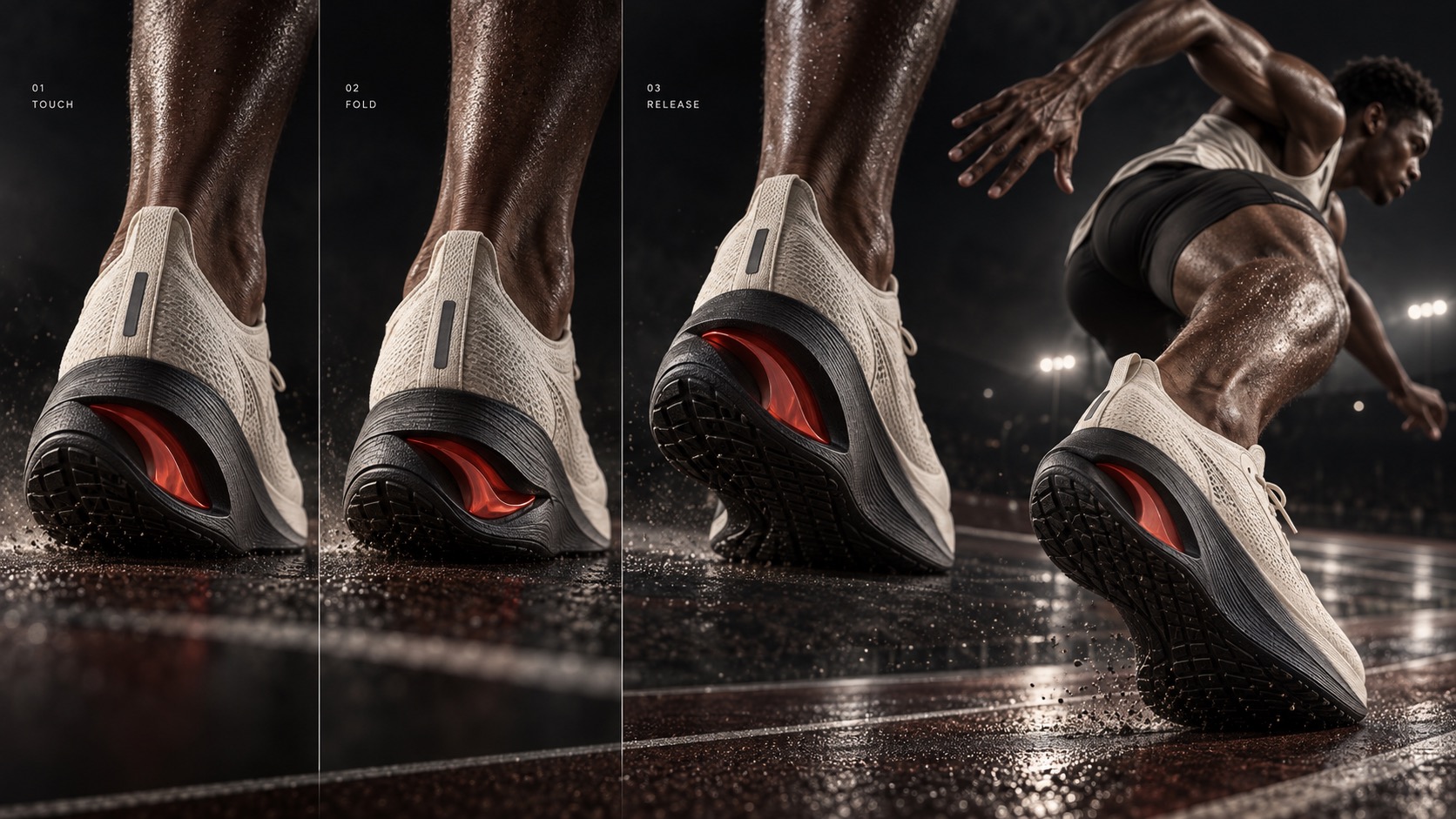
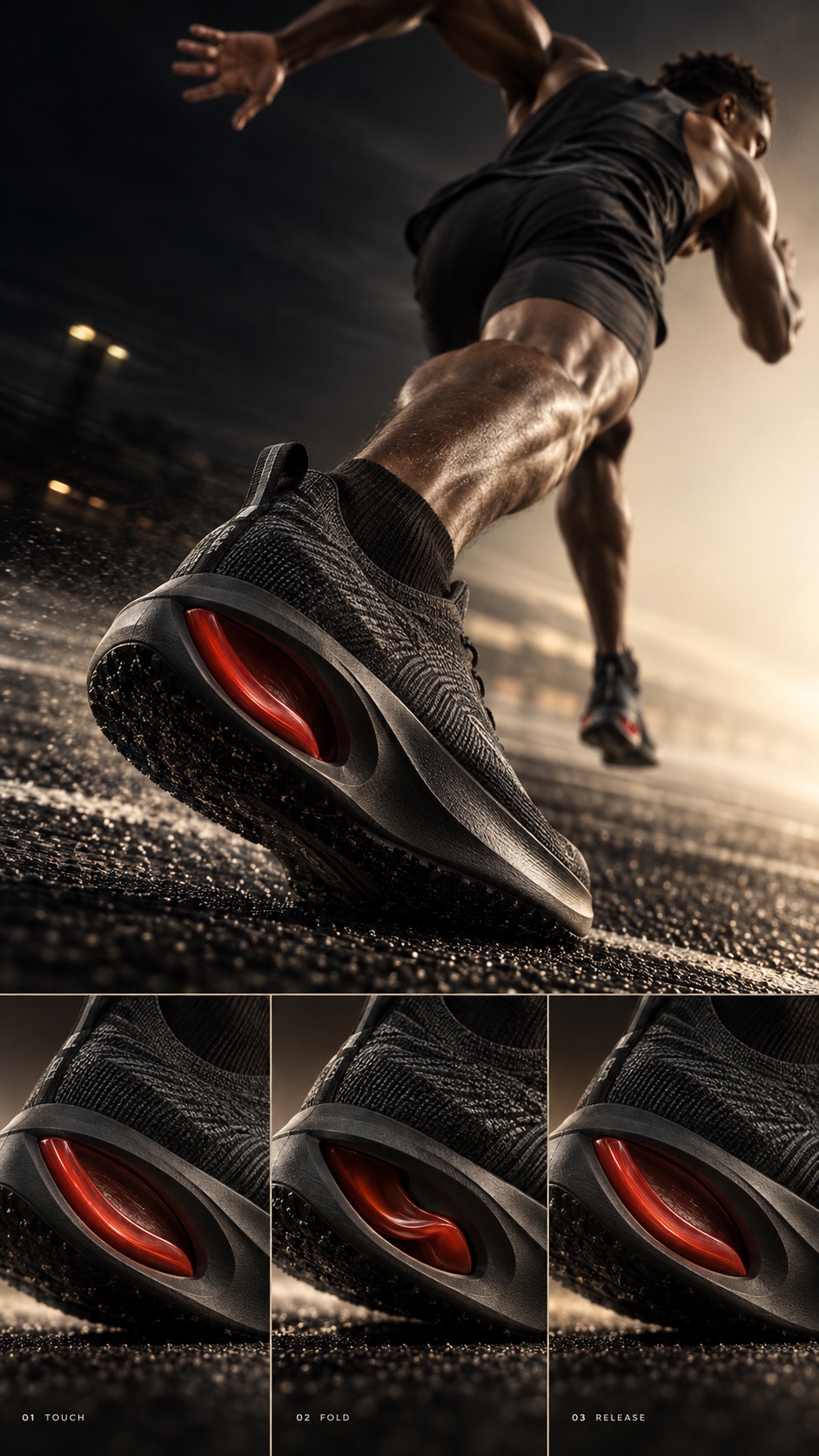
Motion-led footwear campaigns showing a shoe mechanism through action, sequential states, and tactile engineering close-ups.
4 example cases
Same style.json, different subjects. Each case's values are in the examples section of the JSON.
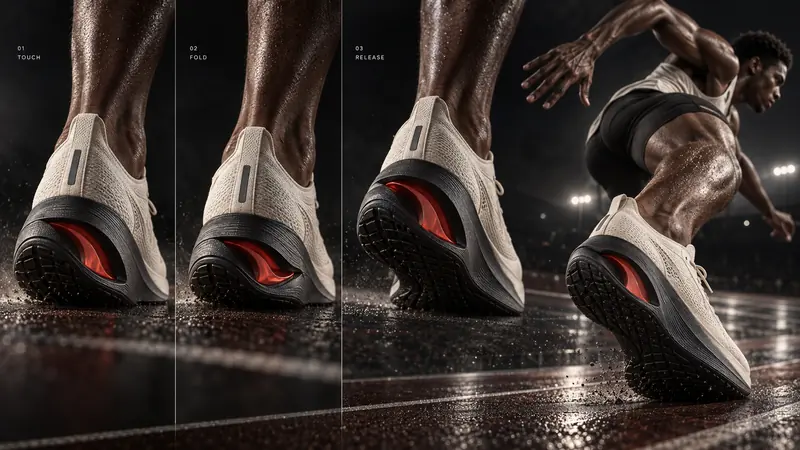
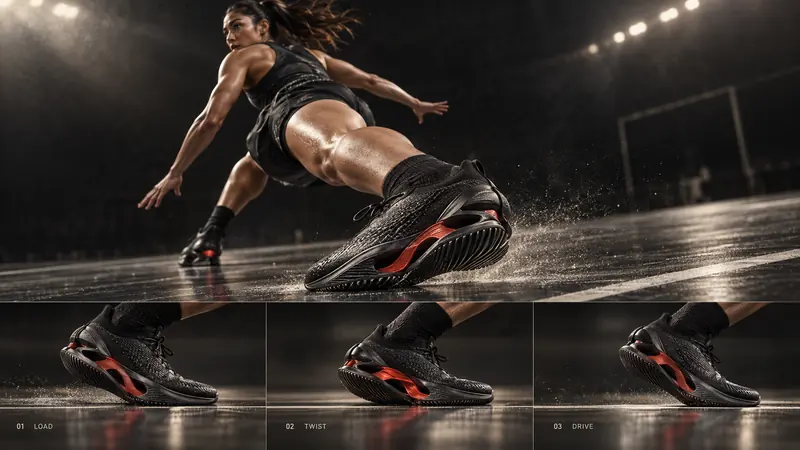
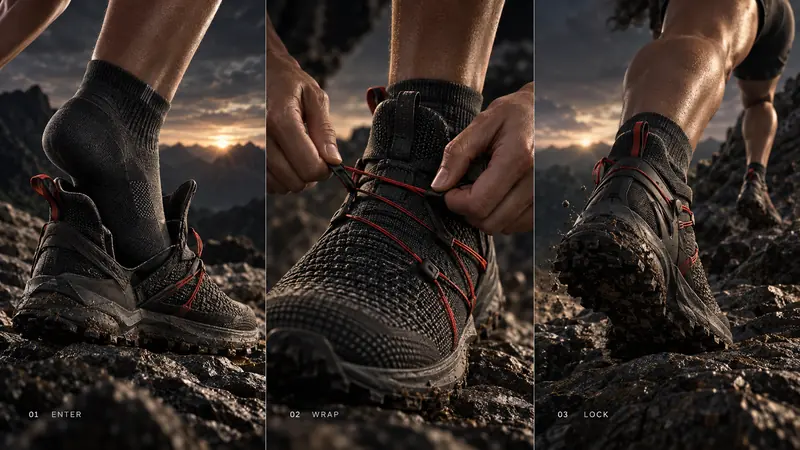
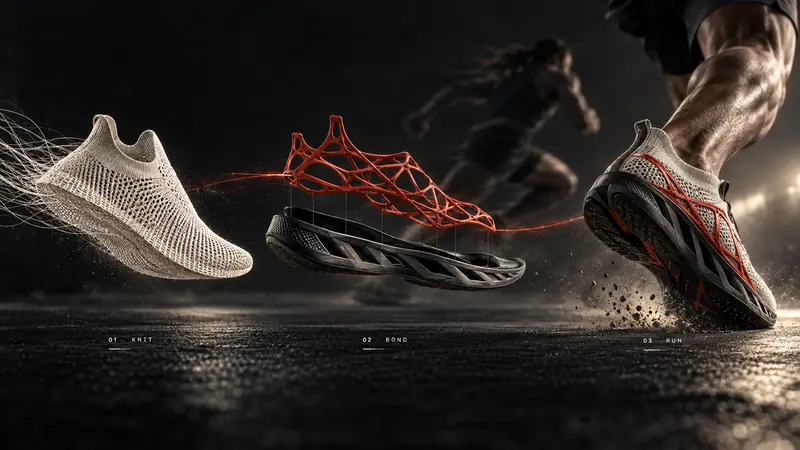
What this style does
A premium, motion-led footwear campaign turns athletic movement into a compact visual process story: a newly invented shoe mechanism is shown through action, sequential states and tactile engineering close-ups, with restrained micro-labels.
Signature traits
- Fuse high-end athletic campaign photography with precise footwear product imagery; show movement and engineering as one connected story.
- Let an athlete, foot or shoe move through a decisive action; use close crops, low camera angles and strong perspective to make the product feel physical and immediate.
- Explain the shoe through three ordered visual states, a cutaway, an exploded construction or tactile material details; the functional change must be visible without long copy.
- Use a controlled palette of obsidian, warm bone and deep vermilion; confine the warm accent to a functional shoe component, motion trace or small process cue.
- Build premium depth with sculpted directional light, precise contact shadows, tactile knit/rubber/carbon surfaces and fine restrained grain.
- Typography is sparse and very small: tiny stage numbers and short labels only, subordinate to the imagery; no hero headline, slogan or large wordmark.
style.json
{
  "style_version": "1.1.0",
  "style_name": "Kinetic Footwear Process",
  "style_slug": "kinetic-footwear-process",
  "style_summary": "A premium, motion-led footwear campaign turns athletic movement into a compact visual process story: a newly invented shoe mechanism is shown through action, sequential states and tactile engineering close-ups, with restrained micro-labels.",
  "environment_variables": {
    "ASPECT_RATIO": "9:16 or 16:9",
    "STYLE_FIDELITY_ANCHORS": "Prioritized kinetic sports-campaign and engineering-story visual system",
    "SOURCE_CONTENT_TO_AVOID": "Reference-specific shoe silhouette, outsole structure, branding and layout",
    "CASE_DIRECTION": "Sport, action, camera energy and visual narrative for this case",
    "SHOE_MECHANISM": "Original footwear architecture and visible material behavior for this case",
    "PROCESS_BEATS": "Three ordered visual states showing a functional change",
    "MICRO_LABELS": "Only short stage labels, rendered very small",
    "SUBJECT": "Athlete, foot or shoe carrying the campaign action",
    "SUBJECT_ACTION": "Decisive athletic movement that reveals the mechanism",
    "PRODUCT_OR_PROP": "Original footwear architecture for this case",
    "LOCATION": "Premium athletic environment serving the process story",
    "BACKGROUND_ELEMENTS": "Motion traces, cutaways and tactile material close-ups",
    "MAIN_TEXT": "Restrained campaign title if lettering appears",
    "SECONDARY_TEXT": "Only short stage labels, rendered very small",
    "ACCENT_SYMBOL": "Warm vermilion confined to a functional shoe part or process cue",
    "WARDROBE_STYLE": "Performance kit that keeps the shoe readable"
  },
  "style_fidelity_anchors": [
    "[CORE] Fuse high-end athletic campaign photography with precise footwear product imagery; show movement and engineering as one connected story.",
    "[CORE] Let an athlete, foot or shoe move through a decisive action; use close crops, low camera angles and strong perspective to make the product feel physical and immediate.",
    "[CORE] Explain the shoe through three ordered visual states, a cutaway, an exploded construction or tactile material details; the functional change must be visible without long copy.",
    "[CORE] Use a controlled palette of obsidian, warm bone and deep vermilion; confine the warm accent to a functional shoe component, motion trace or small process cue.",
    "[CORE] Build premium depth with sculpted directional light, precise contact shadows, tactile knit/rubber/carbon surfaces and fine restrained grain.",
    "[CORE] Typography is sparse and very small: tiny stage numbers and short labels only, subordinate to the imagery; no hero headline, slogan or large wordmark.",
    "[FLEX] Choose an asymmetric split, a short sequence, a diagonal motion path or an exploded view according to the case; avoid repeating one fixed panel template.",
    "[FLEX] Invent a distinct shoe silhouette and mechanism for each case while keeping the material realism, motion energy and small-type discipline consistent.",
    "[FLEX] Recompose each ratio independently so the action and process order stay legible; portrait and landscape are companions, not crops of one layout."
  ],
  "source_content_to_avoid": [
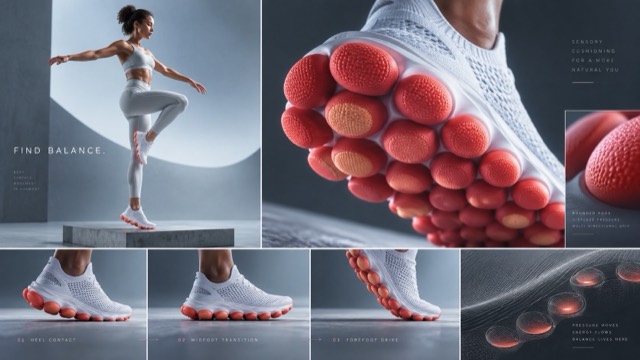
    "The exact Nike Pegasus or Reebok shoe, upper paneling, side profile, sole outline or campaign composition in the supplied references",
    "Repeated round pod cushioning, a long row of orange or red circular outsole cells, or any close copy of the praised MIND 001 shoe",
    "Nike, Reebok or other brand names, swooshes, logos, slogans, trademarks or copied promotional copy",
    "Oversized headlines, giant display lettering, large slogans, dense body copy or fake paragraph text",
    "A browser/gallery screenshot, UI frame, repeated thumbnail rail or a static single-product beauty shot with no process story"
  ],
  "visual_deconstruction": {
    "source": "The admired footwear concept combines sports motion, an unusually large shoe perspective, red structural accents and a modular story board. Carry forward its kinetic image rhythm and engineered sole focus, then refine it with smaller typography, clearer process storytelling and original shoe architecture.",
    "hierarchy": "The athlete's motion and the shoe's functional state change lead. Three process beats and material close-ups support the story. Small numbered labels are secondary."
  },
  "composition": {
    "principle": "Create a finished campaign board that connects one vivid athletic moment to a three-state footwear mechanism story. Use a flexible asymmetric layout with a hero action, sequential detail frames and purposeful negative space.",
    "adaptation": "For 9:16, create a vertical reading path from the action into three tightly composed process states. For 16:9, let the action occupy one side while the mechanism sequence advances across the remaining width. Recompose per case; do not crop one ratio to make the other."
  },
  "typography": {
    "form": "A restrained neutral grotesk, set only as tiny uppercase process words and 01/02/03 counters beside hairline rules.",
    "hierarchy": "Typography occupies at most a small supporting area, never becomes the focal point, and never includes a headline, slogan, wordmark or paragraph."
  },
  "color_palette": {
    "frame": "Obsidian and charcoal shadows balanced with warm bone-white light; deep vermilion or ember red appears only in a functional component or a precise motion cue.",
    "photo": "Natural skin and neutral athletic fabric, muted graphite environments, tactile highlights on rubber, knit and carbon. Avoid candy-colored plastics and broad saturated gradients."
  },
  "photographic_direction": {
    "camera": "Editorial sports photography with forceful low angles, close cropping and controlled motion blur; pair it with clean, high-detail product macro imagery and readable process states.",
    "texture": "Tactile knit, dense rubber, satin composite and carbon-fiber surfaces; preserve believable grain and material separation without plastic gloss.",
    "light": "Premium studio or night-court lighting with deep but detailed shadows, narrow warm highlights and deliberate reflected light on the shoe structure."
  },
  "design_rules": [
    "Every board must show a readable three-state process, not merely a finished shoe beside decorative details.",
    "Invent a new shoe mechanism and silhouette for each case; no repeated circular outsole pods or copied reference shoe.",
    "Keep process labels short, accurate and very small; imagery carries the explanation.",
    "Use the vermilion accent to identify the working mechanism or motion path, never as a large background wash.",
    "Vary the composition to fit each mechanism while retaining the shared campaign lighting, material quality and palette."
  ],
  "do": [
    "Connect the athlete's movement to the shoe's visible state change.",
    "Use macro cutaways, exploded components or restrained force traces when they clarify the sequence.",
    "Keep the stage numbers and labels aligned, crisp and secondary."
  ],
  "avoid": [
    "Large titles or wordmarks competing with the athlete and product.",
    "A fixed shoe shape repeated across all cases or copied round cushioning pods.",
    "Static catalogue layouts, cluttered technical HUDs, unnecessary paragraphs or decorative arrows without a clear function."
  ],
  "negative_prompt": "No oversized headline, giant typography, slogan, brand mark, swoosh, trademark, copied source shoe, repeated circular pod outsole, exact Pegasus or Reebok silhouette, broad red gradient, candy-plastic material, generic catalogue product pose, crowded HUD, fake paragraphs, browser UI, gallery thumbnails, meaningless arrows, unreadable process order, distorted joints, malformed feet, duplicate shoes, floating unrelated objects or low-resolution texture.",
  "prompt_template": "Create one finished premium footwear campaign board in {ASPECT_RATIO}.\\n{STYLE_FIDELITY_ANCHORS}\\nCase story: {CASE_DIRECTION}\\nOriginal shoe mechanism: {SHOE_MECHANISM}\\nProcess order: {PROCESS_BEATS}\\nExact micro-labels: {MICRO_LABELS}. Render only these tiny labels and 01/02/03 counters in a restrained clean uppercase grotesk; text must remain small and crisp, never larger than a discreet annotation. No headline, brand or paragraph.\\nShow the process visually across three ordered states with clear cause and effect, connecting athletic action to a visible change in the shoe. Use a fresh composition suited to this mechanism; integrate one high-impact action image with purposeful sequential process frames or close-ups. In portrait, let the eye travel from action into the three states; in landscape, recompose the action and sequence across the width. Keep generous breathing room and thin panel divisions.\\nUse premium, believable footwear materials, natural anatomy, sculpted shadow, charcoal/obsidian and warm bone light with restrained deep vermilion on the working structure. Do not recreate or edit the references. Exclude: {SOURCE_CONTENT_TO_AVOID}.",
  "examples": [
    {
      "case_name": "impact-window",
      "values": {
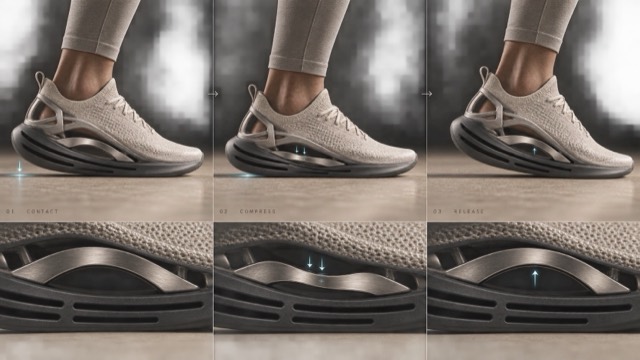
        "CASE_DIRECTION": "A male track sprinter lands hard in a low, forward-driving pose; the shoe fills the near foreground, with the runner and track falling into a dark studio-night background.",
        "SHOE_MECHANISM": "A newly designed off-white road racer with a deep charcoal sole and one sculpted crescent-shaped vermilion flex window in the heel sidewall; a single hollow membrane deforms under load. No pods.",
        "PROCESS_BEATS": "01 heel touch; 02 crescent membrane folds inward; 03 the membrane springs back and lifts the runner forward.",
        "MICRO_LABELS": "01 TOUCH · 02 FOLD · 03 RELEASE",
        "SUBJECT": "A male track sprinter landing hard in a low forward-driving pose, shoe filling the near foreground"
      }
    },
    {
      "case_name": "torsion-spine",
      "values": {
        "CASE_DIRECTION": "A female court athlete cuts sharply across a dark court; use a low rear three-quarter view that shows the planted shoe twisting and the torso counter-rotating.",
        "SHOE_MECHANISM": "A low-profile graphite court shoe with a continuous exposed vermilion carbon ribbon shaped like a narrow S through the midfoot, linking a split heel and forefoot chassis; slim blade traction, no pods.",
        "PROCESS_BEATS": "01 edge load; 02 the carbon ribbon twists through the midfoot; 03 the forefoot releases into the next step.",
        "MICRO_LABELS": "01 LOAD · 02 TWIST · 03 DRIVE",
        "SUBJECT": "A female court athlete cutting sharply, planted shoe twisting as the torso counter-rotates"
      }
    },
    {
      "case_name": "adaptive-weave",
      "values": {
        "CASE_DIRECTION": "A female trail runner pivots onto a dark rock shelf at dawn; frame the shoe and lower leg close, with the upper in sharp focus and the background in deep shadow.",
        "SHOE_MECHANISM": "An original mid-cut trail shoe with a charcoal woven upper and three fine vermilion tension cords that travel diagonally across the instep into a molded heel wrap; no oversized sole pods.",
        "PROCESS_BEATS": "01 foot enters loose; 02 woven cords draw across the instep; 03 the heel wrap settles into a secure locked fit.",
        "MICRO_LABELS": "01 ENTER · 02 WRAP · 03 LOCK",
        "SUBJECT": "A female trail runner pivoting onto a dark rock shelf, shoe and lower leg close to camera"
      }
    },
    {
      "case_name": "layered-assembly",
      "values": {
        "CASE_DIRECTION": "A quiet engineering stage shows an original lightweight trainer being assembled in mid-air, then worn at toe-off by an athlete whose body is only partly visible.",
        "SHOE_MECHANISM": "A distinct low-cut shoe built from a pearl knit shell, a thin vermilion tension lattice and one continuous dark outsole sheet with angular cut-through channels; no separate cushioning pods.",
        "PROCESS_BEATS": "01 knit shell; 02 tension lattice bonds to the chassis; 03 the unified shoe drives into a clean toe-off.",
        "MICRO_LABELS": "01 KNIT · 02 BOND · 03 RUN",
        "SUBJECT": "A lightweight trainer assembled in mid-air, then worn at toe-off by a partly visible athlete"
      }
    }
  ],
  "category": "Product + Campaign"
}